

Last updated: November 8, 2026
Quick Summary
Boots are suitable for regular work and transport, while polo wraps are primarily used for mounted work and recovery. Boots offer a fixed structure and targeted support, while polo wraps provide hand-adjustable compression. Choosing out of habit, without comparing the actual support and the risk of chafing, is a common mistake.
- Correctly applying polo wraps takes three minutes and two checks.
- The finger test remains the best test of a wrap's tension.
- A work boot prioritizes breathability, while a transport boot adds padding.
- A horse that knocks its legs needs a shell, not just a wrap of fabric.
- A well-maintained boot lasts several seasons.
Table of Contents
- Boots or polo wraps: the comparison chart
- What are polo wraps for horses used for
- Horse polo wraps: advantages and disadvantages
- How to apply polo wraps to your horse
- Choosing according to the discipline and the horse's profile
- Care, lifespan and cost of use
- Finding the right equipment in the Équitavi selection
- Frequently Asked Questions
Boots or polo wraps: the comparison chart
Should you protect your horse's legs with boots or polo wraps? The short answer: boots are suitable for regular work and transport, while polo wraps are primarily used for mounted work and recovery.
| Criterion | Boots | Polo wraps |
|---|---|---|
| Application | Two or three straps, in a few seconds | Manual wrapping, 2 to 4 minutes |
| Support | Fixed structure, targeted support | Hand-adjustable compression |
| Main risk | Chafing if poorly fitted | Poor application, uneven tension |
| Breathability | Ventilated panels depending on the model | Fleece fabric, heat buildup |
| Typical use | Work, outings, transport | Mounted work, recovery |
| Care | Easy washing, quick drying | Frequent washing, slow drying |
This chart summarizes the essentials. The rest of this guide explains why each line matters, and in which cases a rider should prefer one piece of equipment over the other.
International Federation for Equestrian Sports, veterinary rules and equine welfare
What are polo wraps for horses used for
They also provide gentle compression and support that some riders seek for a sensitive leg. However, their role remains that of a rudimentary protection: they cushion minor contact, not violent impacts.
The difference with a boot lies in the structure. A boot has a rigid or semi-rigid shell that distributes the impact. A polo wrap relies solely on the thickness of the fabric and the quality of the wrapping.
Horse polo wraps: advantages and disadvantages
The main advantage of polo wraps lies in the fit. The rider controls the tension by hand, which allows them to adapt the support to a sensitive leg or a light session. They also cover a wider area than many boots, and are easily applied to a calm horse in the barn.
The disadvantages are real and often downplayed:
- Heat buildup: fleece fabric does not breathe well, which can heat up the tendons during intense work.
- Risk of poor application: uneven tension creates pressure points.
- Restriction of movement if the wrap is too tight or too low.
- Application time longer than a boot, which weighs on busy days.
Limitations to know before wrapping
A wrap that is too tight can restrict circulation and irritate the tendon. A wrap that is too loose slips and bunches up under the fetlock, with a risk of injury from chafing. Wraps do not protect against a kick or a strong impact. For a horse that knocks its legs, we recommend a structured boot rather than a wrap.
How to apply polo wraps to your horse
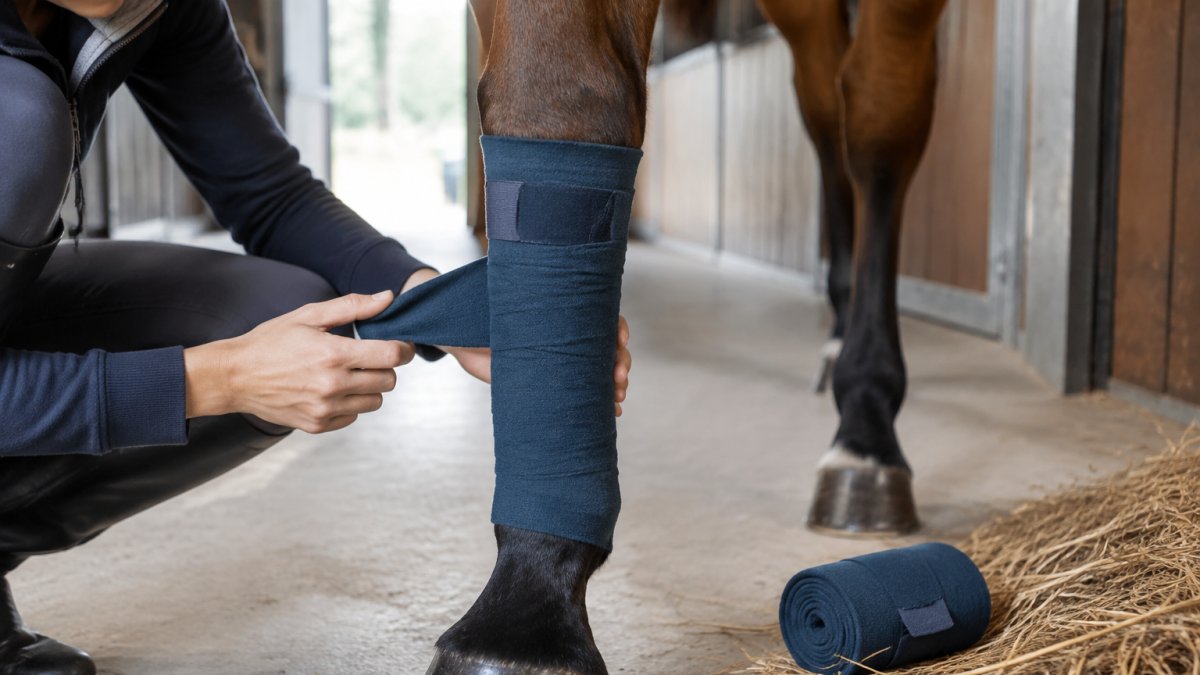
Correct application takes three minutes and two checks. Here is the method we recommend, in order.
Work boots or transport boots
A work boot prioritizes breathability and lightness. A transport boot adds padding and covers more, as the horse remains stationary for a long time. For transport, the Kentucky Horsewear padded wraps remain a popular option for rest and travel.

Warning: a boot that is too tight can restrict circulation and irritate the tendon, even if it seems to hold well. Always check that a finger fits under the straps and that the boot does not twist after a few strides.
Choosing according to the discipline and the horse's profile
The choice between boots and polo wraps does not depend only on the activity, but also on the horse's profile. The same equipment can suit a calm dressage horse and become unsuitable for a young horse that knocks its legs over an obstacle. Here is how to cross the two criteria.
Discipline / situation correspondence chart
| Discipline or situation | Recommended protection | Why |
|---|---|---|
| Dressage | Thin boot or well-applied polo wrap | Freedom of movement, moderate support |
| Daily work | Light and breathable boot | Ease of application, breathability |
| Jumping | Structured boot with shell on the tendons | Shock absorption, tendon protection |
| Cross-country | Reinforced front and back boot | Stronger impacts, varied terrain |
| Transport | Transport boot or padded wraps | Padding, prolonged immobility |
| Recovery | Polo wraps or rest wraps | Gentle compression, flexible support |
This chart provides a basis, but it must be adapted to the horse. A horse that knocks its legs will need a shell even in dressage, while a horse with weak tendons may justify a support boot during a light session.
Criteria related to the horse's profile
- Morphology: a short cannon or a prominent fetlock can make applying wraps more difficult; a well-fitted boot hugs the shape better.
- Skin sensitivity: a horse that reacts to chafing will tolerate a breathable boot better than a fleece wrap that accumulates heat.
- Injury history: after tendonitis, a support boot may be preferred, but it does not replace a veterinary opinion.
- Heat tolerance: on a horse that sweats a lot, polo wraps retain moisture and heat up the tendons; a ventilated boot is more suitable.
- Behavior: a horse that knocks its legs or moves quickly needs structured protection, not just a wrap of fabric.
A horse with sensitive legs tolerates a breathable boot better than a fleece wrap. A horse that knocks its legs needs a shell, not fabric. For a young horse, the Veredus Young Jump hind boots for young horses are designed for this profile.
Warning: never choose a protection solely because it is suitable for the discipline. A horse that knocks its legs in dressage remains a horse that knocks its legs: the shell remains a priority over flexibility.
Care, lifespan and cost of use
A well-maintained boot lasts several seasons. Rinse it with clean water after each session, dry it flat, and check the straps. Polo wraps require more frequent washing, as they absorb sweat and dust. A poorly dried wrap loses its elasticity and becomes irritating.
The real cost is not limited to the purchase price. The replacement liner for Equifit Ultrawool hind boot allows you to replace the worn liner and extend the boot's lifespan. On an Équitavi boot, the replacement liner for Equifit Ultrawool hind boot allows you to extend the lifespan without repurchasing the shell.

The British Horse Society, limb care and bandaging
Find the right equipment in the Équitavi selection
Choosing between boots and polo wraps for your horse means choosing between structure and flexibility.
At Équitavi, our selection of equestrian equipment is based on technical fabrics and cuts designed for movement. Browse the collection and compare models according to your horse, your discipline, and your actual budget.
The real challenge is not choosing a piece of equipment, but choosing the one that suits your horse and your riding style. Équitavi supports you with a carefully selected range, high-performance fabrics, and cuts designed for movement.
Frequently Asked Questions
Do polo wraps offer as much protection as boots?
No, not in the same situations. Polo wraps offer basic protection: they cushion friction and keep tendons warm, but they do not absorb a hard impact like a rigid shell. A boot such as the EQUIFIT Essential Air2 hind boot features a molded shell and reinforced impact zones for knocks and strikes. For jumping or eventing, a boot remains the safer choice; wraps are better suited to dressage and daily work.
In what situations should you choose boots instead of polo wraps?
Choose boots whenever there is a risk of impact or interference: jumping, eventing, pole work, or if your horse touches its legs. Their shell protects the cannon and fetlock without depending on how well they are fitted. Polo wraps remain suitable for dressage, flatwork, turnout, or transport when you are looking for flexible support and tendon warmth rather than a barrier against impacts.
How do you properly fit polo wraps on your horse?
Start with a clean cotton pad or quilted wrap against the skin, without any folds. Wrap the polo wrap from front to back in a regular spiral, covering about half the width with each turn. The tension should be firm but even: you should be able to slide a finger under the wrap. Finish by fastening the Velcro completely flat, never over the joint. After a few minutes of work, check that nothing has slipped or become too tight.
How do you choose the right boot size for your horse?
Measure the height of the cannon between the knee and fetlock, then compare it to the manufacturer's size guide: a boot that is too large will twist and rub, while one that is too small will constrict. Take the horse's conformation into account: a horse with a long, slender cannon will not wear the same size as a horse with a short, wide cannon. Plan to try them on while standing still and then at the walk before heading out for a session, and check that no straps are pinching the skin.
Can polo wraps or boots be left on in the stable?
Always remove wraps and boots after work. A wrap left on can accumulate heat, trap moisture, and create pressure points on sensitive limbs. For rest and transport, choose quilted wraps such as Kentucky Horsewear cotton pads (83 x 46 cm), which are designed for this purpose and machine washable at 30°. The most important thing is to check the skin and tendons every time they are removed.
