

Last updated: October 26, 2026
Quick Summary
Young rider riding gear must meet three criteria: safety, comfort in the saddle, and adaptability to growth. Non-negotiables are a certified helmet, pants with a non-slip silicone seat, and boots that support the ankle.
- Children's riding pants should be made of stretch material and have a thermal lining to adapt to rapid growth
- The helmet must carry an EN 1384 certification in Europe and be readjusted every 2 to 3 months
- Compression socks protect the ankle and toes from boot and stirrup friction
- An initial budget of 490 to 795 euros covers a helmet, pants, boots, shirt, and essential accessories
- Breathable technical clothing wicks away sweat and keeps the child dry during exercise
Table of Contents
- Comfortable riding gear for young riders: the priorities
- Comfortable children's riding pants: mobility and support in the saddle
- Children's riding helmet size and head safety
- Comfortable children's riding boots: foot comfort and stability
- Clothing adapted for riding: breathable shirts and technical base layers
- Beginner children's riding gear: essential accessories and protection
- Fitting gear according to age, body shape, and growth
- Budget and purchasing priorities for starting riding
- Frequently Asked Questions
Comfortable riding gear for young riders: the priorities
Young rider riding gear must meet three criteria: safety, comfort in the saddle, and adaptability to growth. A child who feels comfortable in their outfit will focus on learning, not on chafing or pressure points.
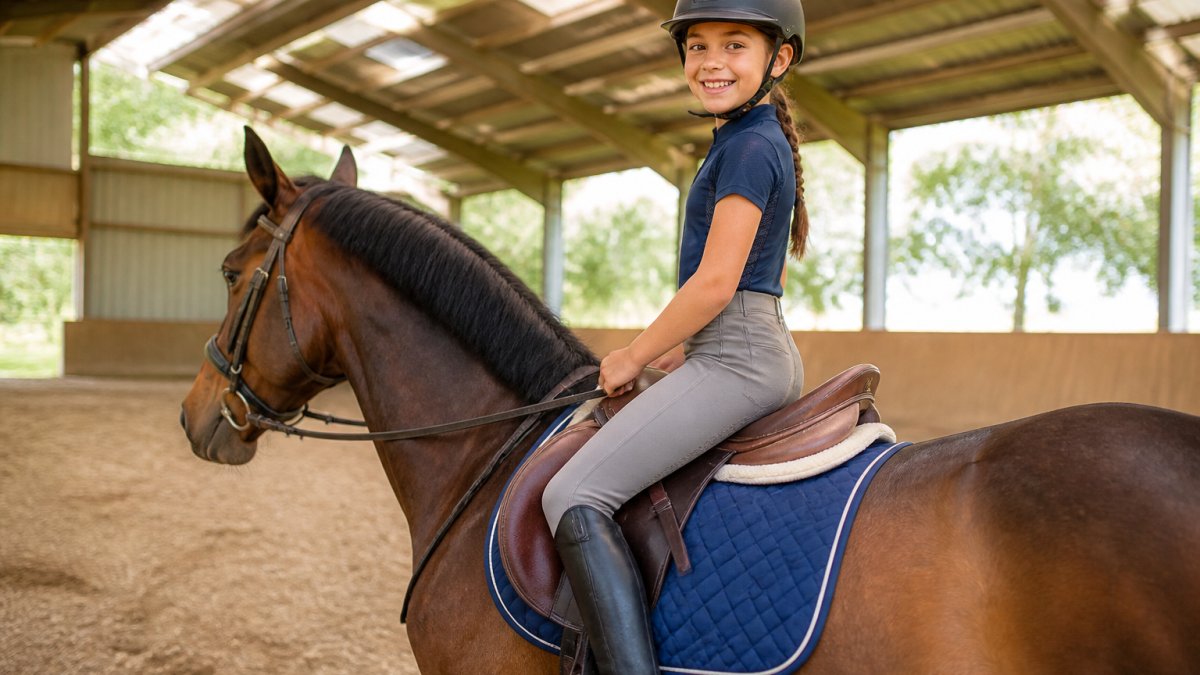
This is why we have carefully selected clothing and accessories designed for young riders.
Beginner rider gear is purchased in stages, starting with the non-negotiables: a certified helmet, suitable riding pants, and boots that support the ankle. Breathable technical clothing and protective accessories then complete this foundation.
Comfortable children's riding pants: mobility and support in the saddle
Comfortable children's riding pants are your foundation: they are the garment in the most contact with the saddle and most subject to friction. A poor choice here ruins the experience, regardless of the quality of the rest.
Look for stretch material that follows movements without restriction, a soft inner lining against irritation, and a non-negotiable non-slip silicone seat: it prevents slipping and offers stability that classic pants do not have.
Non-slip silicone seat and protection against chafing
A full silicone seat is a necessity: it holds the rider firmly in the saddle and absorbs the shocks of the horse's movements. Without it, the child spends their energy holding on instead of working on their position and balance.
The Pants for Girls | Joline SS26 offers a full non-slip silicone seat with a distinctive pattern. The faux pockets on the back are strategically placed to avoid scratching the saddle.

The Josephine Pants for Girls | Joline FW26 and the Amber Pants for Girls | Joline FW26 offer the same protections with slightly different finishes. All three combine safety and style, a point that matters in competition.
Stretch material and thermal lining for growth adaptability
Children grow fast: comfortable children's riding pants must remain flexible for at least a season or two. The stretch material (78% polyester, 22% spandex for the Joline models) allows you to move freely without squeezing the thighs or calves.
The thermal lining regulates body temperature, valuable during the first fall or spring sessions, and creates a soft barrier against irritation from prolonged chafing.
The elastic at the ankles keeps the pants in place without pressure points: a minor detail that changes everything during an hour-long lesson.
Children's riding helmet size and head safety
A well-fitted children's riding helmet is your insurance against head injuries, and the most non-negotiable piece of beginner children's riding gear. No serious lesson starts without a properly secured certified helmet.
A helmet that is too large does not protect, one that is too small compresses.
Check that the helmet carries a recognized safety certification (EN 1384 in Europe, ASTM F1163 in North America). These standards guarantee that the helmet has been tested to absorb shocks and protect effectively.
Tighten the straps under the chin without choking: one finger should fit between the strap and the chin. Readjust this regularly, because a helmet that moves no longer protects.
Comfortable children's riding boots: foot comfort and stability
Comfortable children's riding boots support the ankle while allowing enough mobility.
Look for boots with a flexible but structured sole. The ankle must be well supported, as this is what prevents sprains during rotational movements in the saddle.
The calf fit is crucial: too tight, it cuts off circulation and creates pressure points; too loose, the foot slips and stability in the saddle suffers.
Prioritize breathable and easy-to-clean materials: between mud, sweat, and dust, washable and quick-drying boots save time and last longer.
Clothing adapted for riding: breathable shirts and technical base layers
Children's riding clothing must wick away sweat, allow free movement, and withstand outdoor conditions. A classic cotton shirt keeps the child wet and cold, the opposite of what is needed.
Competition shirts in stretch and breathable fabric
A competition shirt in slightly shiny stretch fabric transforms the look of a young rider, but the fabric must above all be breathable, quick-drying, and wick away moisture: this is what distinguishes a real riding shirt.
The Long-Sleeve Competition Shirt for Girls Josephine | Joline FW26 combines elegance and performance. The 68% nylon fabric offers that slight shine sought in competition, while the cotton collar provides comfort around the neck.

Also check out the Long-Sleeve Competition Shirt for Girls Amber | Joline FW26, which offers the same performance with a slightly different finish. Both are suitable for both training and competitions.
Moisture-wicking base layers for training sessions
Technical base layers are essential for intensive training: they wick away sweat and keep the child dry at a comfortable temperature, even during prolonged exercise.
Vest for Young Girls | Mashang Equine →
The Long-Sleeve Base Layer for Girls | AZTEC DIAMOND FW26 uses an ultra-soft and comfortable sports fabric with a front zipper for a more casual fit. The moisture-wicking and breathable fabric makes all the difference during hot summer days or intense exercise.

For young riders who are getting more involved in riding, the Core Leggings for Girls | AZTEC Diamond FW26 offer a full-seat silicone grip system for optimal grip in the saddle.
Beginner children's riding gear: essential accessories and protection
Children's riding accessories complete the basic equipment and protect against chafing, irritation, and weather variations. They are not options: they are what transform an uncomfortable experience into an enjoyable practice.
Compression socks and mini-chaps for leg protection
Compression socks are not a luxury: they protect the ankle and toes from boot and stirrup friction, and their muscle support helps during exercise.
The Bas Balzane trio | Samshield SS26 are essential socks for young riders. High and compression, they protect the ankle and toes against friction while offering optimal lightness and comfort. Very breathable and quick-drying, they ensure lasting well-being during exercise.
Mini-chaps cover the lower leg and the top of the boot, preventing irritation from repeated contact and offering additional protection in case of a fall.
Light vests and cardigans for seasonal adaptability
Riding is practiced all year round: a light vest allows you to adapt to temperature changes without completely taking off your shirt.
The Cardigan | Joline SS26 is a practical and light vest for children in a fine and stretch material. The beautiful finish in the same style as the pants makes it perfectly matching. A small zipper at the sleeves allows you to adjust the cardigan to any wrist, a detail designed for young riders.
A well-fitted vest also offers an extra layer of protection in case of a fall, although it never replaces a specialized back protection vest for riders who practice more demanding disciplines.
Fitting gear according to age, body shape, and growth
The correct fit of young rider riding gear changes everything: a child uncomfortable in their clothes gives up quickly, a well-equipped child progresses and takes pleasure in their practice.
Take growth into account: a child grows 5 to 7 cm per year between 6 and 12 years old.
Readjust regularly: every three months, check the helmet, boots, and pants. A fast-growing child can go from a perfect fit to a dangerous fit in a few weeks.
Consult the size guides: a size 140 from one manufacturer may correspond to a 146 from another. Measure before buying and check the return conditions.
| Item | Key measurement | Check frequency | Notes |
|---|---|---|---|
| Helmet | Head circumference above the eyebrows | Every 2-3 months | Must be certified and well tightened |
| Pants | Waist size and inseam length | Every 3 months | Stretch fabric to accommodate growth |
| Boots | Calf circumference and leg length | Every 3 months | Secure ankle fit, no slipping |
| Shirt | Chest circumference | Every 4 months | Should allow freedom of movement |
| Socks | Ankle height | Every 2 months | Should fully cover the ankle |
Budget and purchasing priorities for starting out in riding
Starting out with a limited budget requires making smart choices. Here is how to prioritize your initial investment.
The non-negotiables first: a certified helmet, an absolute priority with no room for compromise, followed by suitable riding pants with a silicone seat.
Second: comfortable, well-fitting children's riding boots.
Here is a sample budget for getting started:
- Certified helmet: 80-150 euros
- Riding pants: 100-150 euros
- Riding boots: 100-200 euros
- Technical shirt: 80-120 euros
- Compression socks: 50-75 euros
- Vest or cardigan: 80-100 euros
Total starting budget: 490-795 euros
At Équitavi, we offer a carefully curated selection of riding apparel and equipment that combines performance, comfort, and style.
These products feature technical fabrics, abrasion-resistant seams, and cuts designed for young riders.
At Équitavi, we have compiled this selection for young riders and their parents.
Frequently Asked Questions
What riding equipment is really necessary for a child who is just starting out?
To get started in riding, a young rider needs a certified helmet for safety, comfortable riding pants with a non-slip seat, suitable boots or riding boots, compression socks, a breathable shirt or base layer, and gloves. These items provide protection, comfort in the saddle, and freedom of movement. Équitavi offers Joline pants with a full silicone seat (from €124) and Josephine or Amber shirts (€100) designed specifically for young riders.
How do you choose comfortable riding pants for a child?
Good children's riding pants should have a non-slip silicone seat to prevent slipping, stretch fabric (such as polyester-spandex) for mobility, and an additional thermal lining for prolonged comfort. The high waist with belt loops ensures a good fit. The Joline Josephine and Amber pants (€128) combine these features with strategically placed faux pockets that won't scratch the saddle.
What size riding helmet should you choose for a child?
The helmet size should match the circumference of the child's head. A well-fitting helmet sits firmly without being tight. As children grow quickly, check the fit every 6 months. Choose a helmet certified to safety standards and opt for a model with a removable liner to make it easier to adjust as they grow.
Why invest in technical riding apparel for children?
Technical apparel provides comfort, safety, and durability. Breathable fabrics like those in the AZTEC DIAMOND base layers (€78) wick away moisture and dry quickly, preventing discomfort during lessons. Stretch materials allow the freedom of movement needed for riding. This apparel resists repeated friction in the saddle better and lasts longer than ordinary clothing.
How do you care for riding equipment to extend its lifespan?
Wash riding apparel in cold water (under 30°C) with similar colors to prevent fading and damage to the elastic fibers. Do not use bleach, dry clean, or tumble dry. Air dry in a cool, well-ventilated area away from direct sunlight. Regular, gentle care significantly extends the lifespan of the equipment.
