

Table of Contents
- Horse riding equipment: the essential categories
- Helmets and rider protection
- Horse riding equipment for the rider: clothing and accessories
- Horse riding gear: saddles and basic equipment
- Horse riding equipment for beginners: where to start
- Buying equestrian equipment online: benefits and criteria
- Comparison table of essential equipment
- Frequently Asked Questions
Last update: October 16, 2026
Horse riding equipment: the essential categories
Horse riding equipment allows the rider and their horse to communicate, perform, and stay safe.
Horse riding equipment is divided into three categories: rider protection and clothing, riding gear and horse equipment, and comfort and grooming accessories.
Which horse riding equipment matches your level, discipline, and budget?
Helmets and rider protection
The riding helmet is your first line of defense in the event of a fall: a critical piece of safety equipment subject to strict standards, not just a fashion accessory.
A good helmet combines a rigid shell, an energy-dissipating foam liner, a chin strap, and ventilation.
Choosing a helmet suited to your level
A helmet with a good price-to-quality ratio is sufficient for a beginner. As you progress, you will appreciate ventilation, weight, and fit; competitors look for premium finishes and sophisticated adjustment systems.
At Équitavi, the Miss Shield Glossy Brown Samshield 2.0 Helmet combines high-end polycarbonate, 6-point ventilation, memory foam, and a semi-rigid anti-tilt chin strap.

For a distinctive style, the KOOKI LADY Swarovski Kask Helmet combines Italian design, high standards, a wide visor, and a removable, washable Click-In liner.

Horse riding equipment for the rider: clothing and accessories
Horse riding equipment for the rider goes beyond aesthetics: modern technical fabrics provide freedom of movement, comfort, and durability.
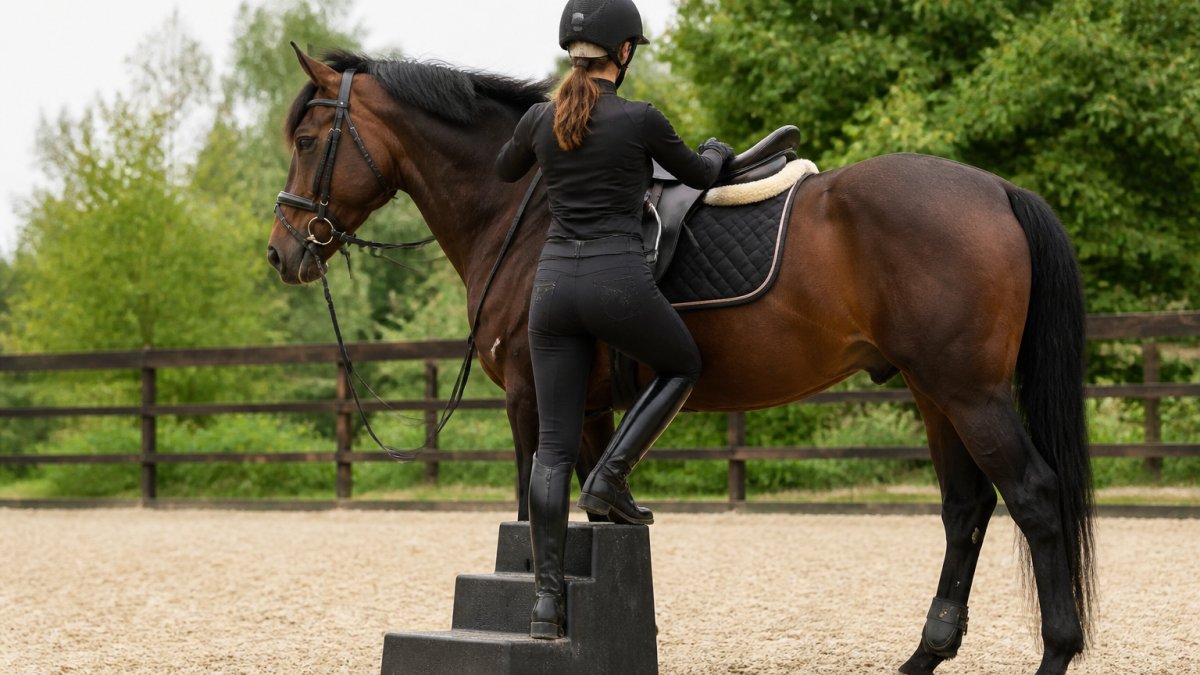
Riding breeches and tops: freedom of movement and comfort
Riding breeches should allow for leg freedom while maintaining light thigh compression, featuring stretch zones and moisture-wicking fabrics.
At Équitavi, we rigorously select our riding breeches for true value for money.
The riding top must allow full shoulder range of motion: if too tight, it hinders precision; if too loose, it bunches up against the saddle.
Riding boots and shoes
Riding boots protect the leg, support the ankle, and clearly transmit aids: soft enough for flexion, stiff enough for lateral support.
Shoes with chaps are sufficient for the leisure rider; competitors prefer boots for their aesthetics and superior support.
Riding gloves and accessories
Riding gloves provide better grip on the reins, even when wet, and protect your hands in the event of a fall.
Horse riding gear: saddles and basic equipment
Horse riding gear is just as important as the rider's: an ill-fitting saddle causes back problems, and a poorly adjusted bridle hinders communication. Here are the concrete criteria we use at Équitavi.
Saddle: fit, anatomy, and budget
The saddle, the point of contact between you and your horse, must match its anatomy to distribute your weight evenly.
How to check saddle fit:
- Run your hand under the pommel: you should feel even pressure without pinching.
- Check that the channel of the saddle (the space between the panels) allows for two to three fingers' width along its entire length.
- After a session, look for uneven sweat marks or rub marks on the horse's back.
Selection criteria by level:
- Beginner / leisure: a verified second-hand all-purpose saddle may suffice. Favor brands recognized for durability and check the condition of stitching, leather, and the tree.
- Intermediate: a new entry-level saddle or a recent high-quality used one. Fit takes precedence over aesthetics.
- Competition: a discipline-specific saddle (dressage, jumping, cross-country) with a custom or semi-custom fit. Used high-end brands remain a viable option.
Buying second-hand: inspect the tree (no cracks), the panels (no depressions or hardening), the stitching (no loose thread), and the leather (no cracking). Ask for the history and test the saddle if possible.
Saddle pads, fly veils, and half pads: comfort and protection
A saddle pad provides cushioning and protects the back; a half pad absorbs shock.
Selection criteria:
- The pad must be adapted to the shape of the saddle and the horse's back.
- Fly veils protect the ears from insects and noise. They must be fitted without being too tight.
- Half pads are useful for sensitive horses or during long sessions. They do not replace a well-fitted saddle.
Maintenance: wash pads and fly veils at 30°C maximum, without fabric softener, and air dry away from sunlight.
Bridle, bit, and riding accessories
The bridle is your main tool for communication. A well-fitted bridle sits comfortably on the head without pressure points: snug enough to stay in place, without restricting the jaw.
How to check the fit:
- The bit should rest against the corners of the lips without causing wrinkles or pulling at the corners.
- The headstall should pass behind the ears without folding or compressing them.
- The cheek pieces must be symmetrical and not overly tight.
Selection criteria:
- Beginner: a simple bridle in leather or easy-to-maintain synthetic material. Straight or single-jointed bits are generally well tolerated.
- Intermediate: favor quality leather, which is more durable and comfortable for the horse. Anatomical bits can improve comfort.
- Competition: discipline-specific bridles (dressage, jumping) with bits adapted to the horse's training level. The choice of bit should be validated by a professional.
Buying second-hand: check the condition of the leather (no cracking), stitching, and buckles. For bits, inspect for wear and rust. Always clean and disinfect a second-hand bit before use.
Horse protection and comfort
Beyond the saddle and bridle, protective gear (boots, bell boots, fetlock boots) prevents knocks and rubbing, rugs protect against weather and insects, and sheets and quarter sheets add comfort.
Miss Shield Glossy Brown Helmet | Samshield 2.0 →
Selection criteria:
- Protective gear must be adapted to the discipline and terrain. For cross-country, prioritize reinforced protection; for dressage, lightweight and discreet boots.
- Rugs should be chosen based on temperature, clipping, and the horse's sensitivity. An overly warm rug can cause overheating.
- Regularly check the condition of fastenings and straps to prevent injuries.
Maintenance: clean protective gear after each use with clear water or mild soap, air dry; machine wash rugs at 30°C and re-waterproof if necessary.
Safety stirrups: a choice that protects
Safety stirrups, such as Flex-On Safe-On Stirrups, protect in the event of a fall: made in France from eco-friendly polyamide, they incorporate a release mechanism that prevents the rider from being dragged.

For a more accessible budget, the Flex-On Composite Stirrups offer the same benefits at a competitive price, with shock absorption and Flex-On ergonomics.
Selection criteria:
- Verify that the stirrups are adapted to your foot size and discipline.
- Safety stirrups are particularly recommended for beginner riders, children, and high-risk disciplines (cross-country, jumping).
- Regularly inspect for wear on the arms and the release mechanism.
Horse riding equipment for beginners: where to start
As a beginner, there is no need to buy the most expensive horse riding equipment: invest in the non-negotiable elements for safety and comfort.
Prioritize the helmet, then comfortable breeches and suitable boots or shoes, along with gloves and a technical top.
Add other accessories based on your discipline and goals: beginner horse riding equipment does not need to be complete right from the start.
Buying equestrian equipment online: benefits and criteria
Buying equestrian equipment online expands the selection, facilitates price comparison, and offers home delivery, but prevents trying things on. At Équitavi, we compensate with a rigorous selection and expertise to guide you.
Online selection criteria: fit, size, and compatibility
Before confirming an online purchase, ask yourself the right questions:
- Helmet: measure your head circumference (above the eyebrows, at the widest point). Each brand has its own sizing; refer to the size guide and read reviews about the fit. A helmet should be stable without being tight. Check for an adjustable chin strap and a washable liner.
- Saddle: seat size depends on your body type and discipline. The panel size depends on the horse's conformation. When shopping online, prioritize saddles that offer a trial period or a clear return policy. Check the width of the wither and the shape of your horse's back before ordering.
- Saddle pads and half pads: they must match the shape of the saddle and the horse's back. A pad that is too large can cause chafing; if it is too small, it will not provide proper protection.
Compatibility: ensure that accessories are matched (saddle pad suited to the saddle, stirrups suited to your foot size).
Quality, safety, and standards: what justifies the investment
The quality of equestrian equipment is measurable: helmets must meet strict standards (EN 1384 or equivalent) and bear a conformity marking; technical fabrics must prove their durability, and saddles must meet high standards.
Signs of wear to monitor:
- Helmet: replace it after any significant impact, even without visible damage. The internal foam may be compromised. Also check the condition of the straps and the chin strap.
- Saddle: regularly inspect the stitching, panels, and tree. Cracked leather or sagging panels indicate that it is time to have the saddle serviced or replaced.
- Stirrups: check the wear on the branches and the proper functioning of the release mechanism.
Investing in quality equestrian equipment makes your horse more comfortable and performs better.
Overall budget and value for money
The budget depends on your level, your discipline, and your frequency of practice. Second-hand branded gear can be an interesting alternative.
Essentials: compliant helmet, closed-toe shoes, appropriate breeches, gloves, fitted saddle, bridle, basic grooming kit. Optional: working boots/wraps, blankets, fly veils, half pads, safety stirrups (recommended but not mandatory).
Maintenance and lifespan: preserving your equipment
Clean leather with appropriate soap and nourish it with balm; regularly inspect stirrups; wash boots and saddle pads according to instructions.
Storage: store equipment in a dry, ventilated place, protected from moisture and rodents; do not compress helmets or protective boots.
With proper maintenance, good equestrian equipment can last for years.
Second-hand purchase: inspection criteria
Buying second-hand is economical but requires rigorous inspection.
- Helmets: never buy a second-hand helmet if you do not know its history. A helmet that has suffered an impact may appear intact but have a compromised internal foam. If in doubt, abstain.
- Saddles: inspect the tree (no cracks), panels (no dents or hardening), stitching (no loose threads), and leather (no cracking). Request detailed photos and try the saddle if possible.
- Bridles and headstalls: check leather, stitching, and buckles; for bits, inspect for wear and rust. Always clean and disinfect a second-hand bit.
By following these criteria, buy online with confidence, for both new and used items.
Comparison table of essential equipment
| Category | Type of equipment | Beginner level | Intermediate level | Competition level |
|---|---|---|---|---|
| Protection | Riding helmet | Basic helmet meeting standards | Helmet with optimal ventilation | High-performance helmet (Samshield, Kask) |
| Clothing | Riding breeches | Cotton blend | Technical stretch fabric | High-performance moisture-wicking fabric |
| Footwear | Boots/shoes | Basic shoes + gaiters | Half-height boots | Full leather boots |
| Accessories | Riding gloves | Simple gloves | Gloves with reinforced grip | Premium leather gloves |
| Saddle | Saddle equipment | Checked second-hand saddle | Entry-level new saddle | Custom or high-end saddle |
| Stirrups | Safety equipment | Standard composite stirrups | Flex-On Composite stirrups | Flex-On Safe-On stirrups |
| Horse protection | Accessories | Basic saddle pad | Pad + half pad | Complete protection kit |
Choosing the right equestrian equipment for your practice affects your safety, your comfort, and that of your horse. At Équitavi, our rigorous selection combining performance, comfort, and style meets the needs of every rider. VIEW COLLECTION to discover our complete range of equestrian equipment and invest in your equestrian passion with confidence.
Frequently Asked Questions
What equipment is mandatory to start riding?
To get started, mandatory equipment includes a certified riding helmet (such as the Samshield 2.0 or Kask Kooki models), riding boots or shoes, riding breeches, a technical shirt or top, and gloves. For the horse, a saddle, a bridle, and a saddle pad are essential. Rider protection remains the absolute priority: the helmet must meet high safety standards.
How do I choose beginner riding equipment without making a mistake?
As a beginner, prioritize quality and fit rather than quantity. Start with a certified helmet that fits your head perfectly, comfortable riding breeches and a top that offer freedom of movement, and boots with good support. For the horse, invest in a saddle that fits its conformation well. Consult your instructor or a saddlery expert to check the fit. Good starter equipment will last several years.
Why buy equestrian equipment online instead of in a store?
Buying equestrian equipment online offers several advantages: access to a rigorous selection of renowned brands and expert consultations available. The Flex-on Safe-On stirrups (448 €) and Samshield 2.0 helmets (790 €) available online combine safety, ergonomic comfort, and durability. Customer reviews and detailed technical sheets help you verify quality before purchasing.
What budget should I plan to be properly equipped for horse riding?
This initial investment is justified by the lifespan of the equipment (5-10 years) and above all by the safety and comfort it provides.
How do I check the durability and quality of riding equipment?
Check the materials used: polycarbonate for helmets (same material as motorcycle helmets), eco-friendly polyamide for stirrups, leather or technical textiles for clothing. Consult safety standards (mandatory certifications for helmets), the presence of robust adjustment systems (memory foam, semi-rigid chin strap), and the possibility of easy maintenance (washable liners, cleaning with water). The brands selected by Équitavi offer a quality guarantee and a superior lifespan.