

Table of Contents
- Riding competition jacket: what changes between children and adults
- Comparison of Équitavi competition jackets
- How to choose a riding competition jacket
- Lightweight and breathable riding competition jacket: the fabrics that make the difference
- Riding competition dress code: what the judge expects
- Affordable riding competition jacket: where the real value lies
- Care, washing and durability of your jacket
- Conclusion
- Frequently Asked Questions
Last updated: October 21, 2026
Riding competition jacket: what changes between children and adults
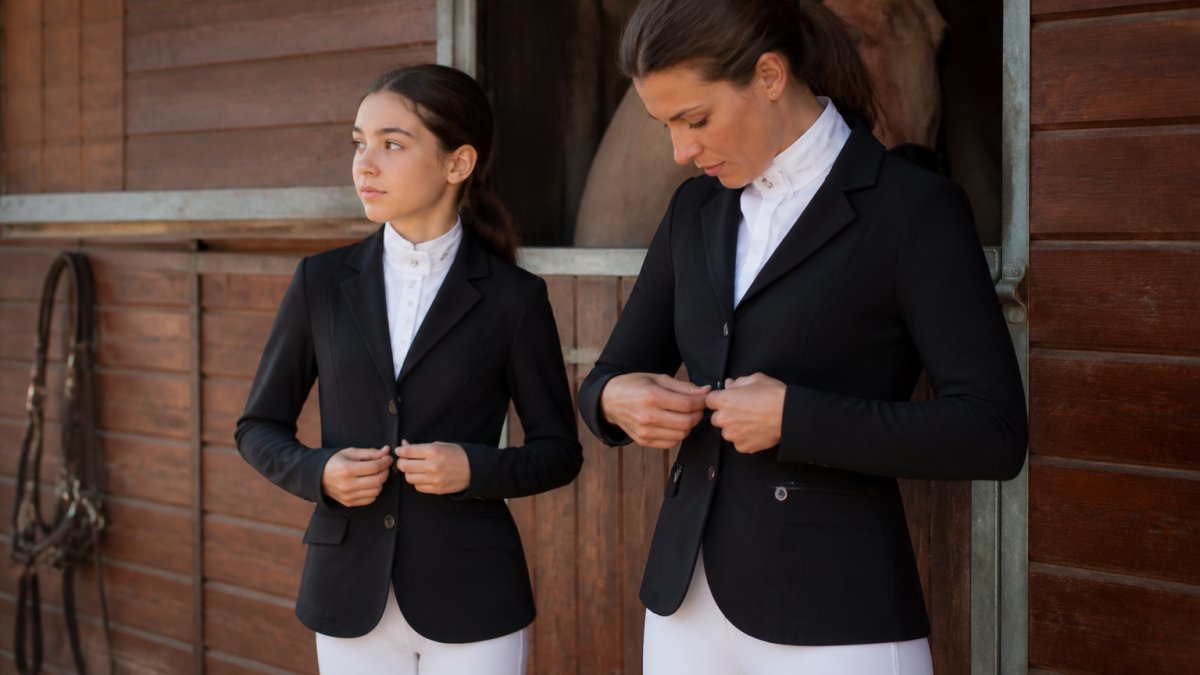
The competition jacket for children or adults meets the same basic requirement: a clean fit, fabric that follows movement and an impeccable appearance before the judges. At Équitavi, we see riders of all ages every season, and the difference between a children's jacket and an adult jacket rarely comes down to style. It comes down to proportions, growth and level of use.

A competition jacket is a technical garment worn in competition, designed to stay in place during exertion while respecting the dress code of the discipline. The detail that changes everything: a child grows several sizes in one season, an adult keeps the same jacket for years.
International Equestrian Federation, competition rules
This is why we systematically distinguish the two ranges in our selection. Here is what really differs, and how to choose without making a mistake.
Tailored fit and freedom of movement
A tailored fit is not an aesthetic whim. A jacket that is too wide rides up at the shoulders during jumping and hides the position of the torso. A jacket that is too tight restricts the opening of the shoulders when passing over the obstacle.
For adults, a slim-fit tailored cut works well: the shoulders remain free, the waist is defined, and the sleeves fall at the wrist. For children, the priority is reversed. There must be room at the shoulders and elbows, because young riders move much more and grow quickly.
Sizes, rider age and measurements
Children's sizes follow the approximate age, but age often lies. A 10-year-old child can wear size 8 or size 12 depending on their build. The chest measurement remains the most reliable benchmark.
| Benchmark | Child | Adult |
|---|---|---|
| Size basis | Age and chest circumference | Chest circumference and waist circumference |
| Growth margin | One size up recommended | No margin necessary |
| Sleeve length | Should cover the wrist without excess | At the wrist, without creasing |
| Replacement | Often every season | Several years |
Take the measurements with the rider in light clothing, arms at their sides. Measure the chest circumference at the widest point, then the waist circumference at the narrowest. Compare with the model's size guide, never with the age label alone.
Comparison of Équitavi competition jackets
Our selection covers both audiences with comparable technical fabrics and price differences that mainly reflect the finish and the brand.
| Model | Audience | Price | Highlights |
|---|---|---|---|
| Louise Sculpt Samshield FW26 Competition Jacket | Women | 617.00 | Shaping French fabric, stretch mesh lining, breathable, quick-drying, UPF 50+, wrinkle-resistant, Airbag Zip'in compatible |
| Aztec Diamond FW26 Competition Jacket | Women | 340.00 | 4-way stretch, moisture-wicking, laser-cut back insert, two zippered pockets |
| Aztec Diamond Competition Jacket | Women | 300.00 | Same technical construction, 78% nylon 22% spandex fabric |
| Aztec Competition Jacket for Girls | Children | 185.00 | 4-way stretch fabric, ventilated back panel, two zippered pockets |
| Mashang Equine Competition Jacket for Young Girls | Children | 130.00 | Comfort for young riders, bright colors, easy care |
The Louise Sculpt Samshield FW26 Competition Jacket is designed for demanding competition. The Aztec Competition Jacket for Girls follows the same technical logic on a young rider's scale, at a much lower price.

How to choose a riding competition jacket
Choosing a riding competition jacket means weighing three criteria: material, closure, and intended competition level. Design comes last, never first.
Materials, stretch and comfort
Technical fabrics dominate today, and for good reason. A nylon and spandex blend, such as the 78% nylon 22% spandex of the Aztec Diamond Jacket, offers 4-way stretch that follows the opening of the shoulders. Wool is still present in some classic jackets, but it requires more care and is less forgiving of fit discrepancies.
Stretch is twice as important for a child. A young rider leans forward, stands up, adjusts their stirrups: the jacket must follow along without pulling at the seams.
Closure, collar and finishes
Button closure remains the standard in classic competition. Reversible buttons allow you to change the visible color depending on the occasion, a detail appreciated by families who want one jacket for several events.
The collar should stand straight without being tight. Front zippered pockets, found on the Aztec Diamond models, are a real practical plus: they prevent losing a glove in the paddock. The sleeves and stitching finishes reveal the real quality of a jacket, much more than the logo.
Lightweight and breathable riding competition jacket: the fabrics that make the difference
A lightweight and breathable competition jacket changes comfort on a competition day, especially in summer. Anti-perspiration and quick-drying technologies prevent the damp feeling between two events.
Laser-cut back inserts, like on the Aztec Diamond models, create real ventilation in the back. The stretch mesh lining of the Louise Sculpt model plays the same role while maintaining a clean line. For a child who goes from one event to the next, this breathability matters as much as the fit.
Technical fabric guide for sports
Louise Sculpt Competition Jacket | Samshield FW26 →
Riding competition dress code: what the judge expects
The riding competition dress code requires a jacket in a sober color, generally black or navy blue, a closed collar and a generally neat appearance. The rules vary depending on the discipline and level, and local requirements may specify details.
What the judge looks at first: the cleanliness of the jacket, the alignment of the buttons and the collar's appearance. A well-cut but wrinkled jacket loses impression points. A simple, impeccable jacket makes a better impression.
Always check the rules of your event before confirming your outfit. The rules of CSO and dressage are not identical, and an amateur competition does not expect the same thing as a final.
Affordable riding competition jacket: where the real value lies
An affordable riding competition jacket costs between 130.00 and 185.00 with us for a child, and from 300.00 for an adult. Below that, be wary: the seams and fabrics degrade quickly.
The real value is not the lowest price. It is the price relative to the number of seasons of use. A children's jacket at 130.00 worn for one season costs more than an adult jacket at 340.00 worn for five years.
Care, washing and durability of your jacket
Washing at 30 °C maximum significantly extends the life of a technical jacket. Manufacturers recommend washing at a low temperature, with similar colors, then air-drying on a hanger to avoid creases.
Avoid the dryer, bleach and dry cleaning on elastic fabrics: they damage the fibers and cause them to lose elasticity. Remove excess water without wringing, then let dry in the shade.
A well-maintained jacket retains its shape and color. This is especially true for children's models, which are often worn several times a week.
Conclusion
Choosing between a children's and an adult show jacket is nothing complicated once the right criteria are established: chest measurement, room to grow for younger riders, and fabric quality for adults. The real difficulty is resisting the urge to buy a size too large "just in case".
At Équitavi, our selection brings together high-performance technical fabrics, cuts designed for movement, and guidance to help you find the right size. Browse our collection of show jackets and find the model suited to your body type and level.
Frequently Asked Questions
Is a show jacket mandatory in equestrian competitions?
In most show jumping and dressage competitions, the show jacket is part of the required attire in the arena. The rules of each discipline and event specify the tolerances, especially for young riders and club-level events. Before heading out without a jacket, check the rules of your competition. A sober, well-cut, and buttoned jacket remains the safest bet for presenting yourself to the judge without comment.
How to choose an equestrian show jacket for a child?
Opt for a cut that leaves the shoulders free and sleeves that stop at the wrist without pulling. Take your child's measurements at the time of purchase, as body shape changes quickly: chest circumference, back length, and arm length. A four-way stretch fabric forgives size differences between growth spurts. Budget-wise, the Aztec girls' show jacket at $185 or the Mashang Equine girls' jacket at $130 will easily cover the first few seasons of competition.
How to choose a comfortable show jacket suited to your body type?
The jacket should follow the upper body without compressing the shoulders or restricting torso rotation. Try it on with your show shirt and back protector, arms extended in front of you then above your head. A stretch mesh lining and four-way stretch fabric make a noticeable difference on a competition day. If you are between two sizes, know that some models run small: this is the case with the Aztec Diamond jacket, which should be taken one size up.
What alternatives to a classic show jacket can be worn?
Some riders turn to a lighter technical jacket, a structured show vest, or an unlined jacket for summer events. These alternatives remain acceptable as long as they respect the color, cut, and level of formality required by the event rules. A lightweight and breathable show jacket, such as nylon and spandex models, often offers the best compromise between a polished presentation and comfort in the heat.
How to maintain a show jacket so it lasts several seasons?
Wash your jacket at 30°C maximum, with similar colors, and avoid the dryer. Manufacturers recommend air drying on a hanger to limit wrinkles and preserve the elasticity of the fibers. No bleach, no dry cleaning, no prolonged soaking. Store the jacket on a wide hanger rather than folded, and brush off dust after each competition. Regular maintenance keeps the fabric wrinkle-free and the cut in place.
The next competition deadline is approaching and the right size is quickly being reserved. Équitavi supports you with a rigorous selection, proven technical fabrics, and cuts designed for movement. Discover our collection and prepare your next entry into the ring with a jacket tailored to you.
VIEW COLLECTION