

Table of Contents
- Why an ill-fitting horse girth hinders performance
- Short or long horse girth: compatibility with your saddle
- Horse girth size: the precise measurement protocol
- Anatomic horse girth: straight, anatomic, or shaped
- Girth tightening: billets, elastic, and saddle stability
- Materials, comfort, and signs of discomfort to watch for
- Maintenance, lifespan, and replacing your girth
- Frequently Asked Questions
Last update: October 12, 2026
Why an ill-fitting horse girth hinders performance
An poorly chosen girth restricts breathing, creates pressure points, and causes the horse to hold back its effort.
Knowing how to choose a girth that is suitable for your horse is first and foremost a matter of comfort and freedom of movement.
The saddle girth is the piece that connects the saddle to the horse's body. It is what transmits every pressure.

Short or long horse girth: compatibility with your saddle
The rule is simple: the length of the girth depends on the type of saddle, not on your preference. A monoflap saddle requires a short girth. A dressage or eventing saddle often accepts a long girth.
A short girth sits high on the saddle flap. A long girth hangs low and attaches near the girth groove. Choosing wrong creates a pendulum effect that destabilizes the entire saddle.
Monoflap, dressage, and eventing saddles: what changes
The type of saddle changes everything. Here is how you identify the right model:
- Monoflap saddle: short girthing, short billets, short girth mandatory.
- Dressage saddle: long girthing frequent, long girth that contours the flank.
- Eventing saddle: often long girthing, with priority on elbow clearance.
The flap and the position of the billets dictate the length. Look at your saddle before buying.
Horse girth size: the precise measurement protocol
Girth size is measured with the saddle in place, without a girth, on a relaxed horse, and ideally after a few minutes of walking so the horse has exhaled.
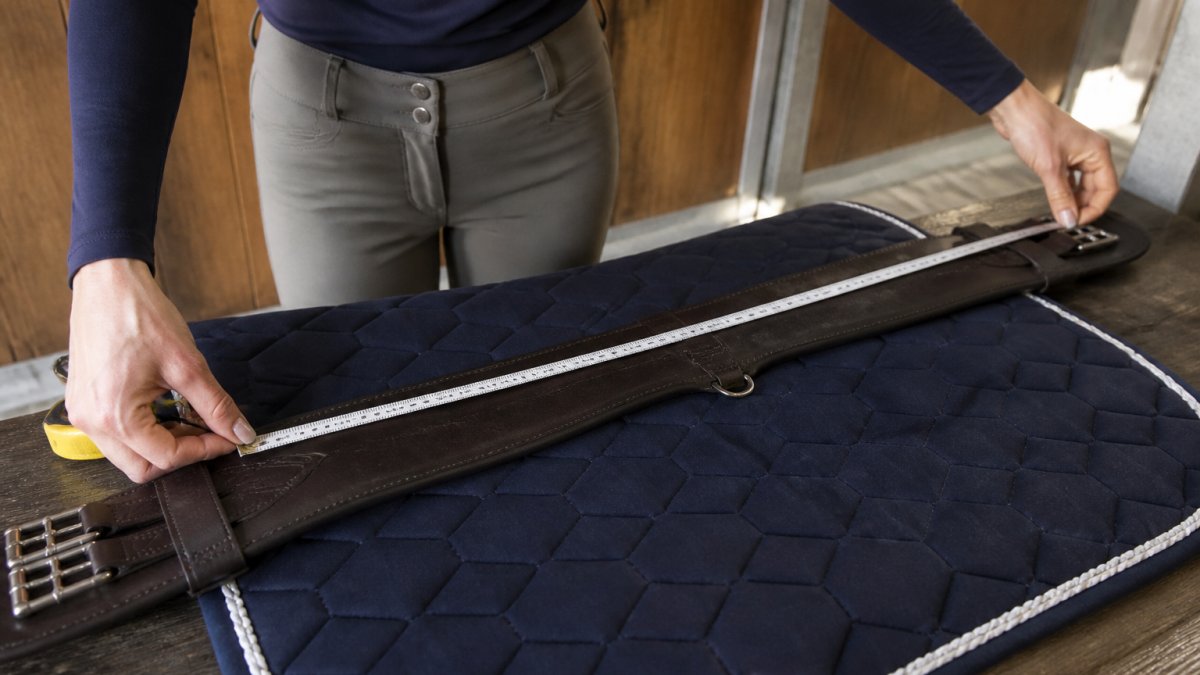
The step-by-step protocol
- Saddle up without a girth, with the pad in place and the saddle centered on the back.
- Locate the attachment point of the billets on each side (the bottom of the billet, where the girth buckle will be attached).
- Pass the tape measure under the belly, from the left attachment point to the right, following the natural line of the girth groove (just behind the elbow, not in the hollow of the flank).
- Note this measurement in centimeters: this is the useful length.
- Add the length of the two billets if you are measuring to their top ends rather than their attachment point. Most manufacturers indicate girth size buckle-to-buckle, excluding the billets.
- Round up to the nearest commercial size (sizes often go in 5 cm increments).
A reliable benchmark: the lower buckle of the girth should be located midway up the flank, between the bottom of the girth groove and the top of the elbow. If you are hesitant between two sizes, take the larger one and check the adjustment of the billets: it is better to be able to tighten a little more than to lack length.
Pitfalls that skew the measurement
- Billets of different lengths: measure both sides and take the average, or correct the adjustment first.
- Saddle too far forward or backward: the girth groove line changes, so the measurement changes.
- Horse that has lost weight or gained muscle: remeasure after a change in work or season.
Checking the size once the girth is received
Once the girth is received, girth up without tightening and check three points:
- The buckles remain in the middle of the flank, never under the elbow.
- The billets are not pulled tight on one side and loose on the other.
- There are at least two to three adjustment holes available on each side.
If the girth goes up too high and the buckles brush against the elbow, it is too short. If the buckles fall below the flank and the billets are tightened to the maximum, it is too long. In both cases, change the size rather than compensating with the adjustment.
When to seek professional advice
If after two attempts with different sizes the girth floats, turns, or slides up, the problem is likely not the size but the position of the billets or the saddle fit. A saddle fitter or qualified saddler can check the girthing line and the stability of the entire system. Self-assessment has its limits: an ill-fitting saddle cannot be fixed with a girth, even one perfectly sized.

Anatomic horse girth: straight, anatomic, or shaped
The shape of the girth changes the distribution of pressure. A straight girth suits many horses. An anatomic horse girth follows the shape and frees the elbow. A shaped/offset girth shifts the pressure toward the rear.
The choice depends on the horse's conformation and body type: here is how to choose a girth suitable for your horse.
- Straight girth: simple, stable, good basic choice.
- Anatomic girth: curved, reduces friction on sensitive horses.
- Shaped girth: moves the pressure point back, useful when the elbow is close to the girth groove.
Elbow clearance and freedom of movement
The elbow is the most fragile area. A girth that blocks the elbow limits shoulder extension. The horse shortens its stride. Good elbow clearance restores freedom of movement to the entire shoulder.
Girth tightening: billets, elastic, and saddle stability
Properly girthing your horse means tightening in stages, never all at once. Tighten one side, then the other, and alternate. The horse must be able to breathe freely.
The billets connect the girth to the saddle. Their length changes the final position of the girth. Elastic, for its part, distributes pressure and absorbs shocks. A girth without elastic offers more direct contact, but less flexibility.
Diagnosing saddle stability problems
A saddle that turns or slips often signals a girthing problem. But not all instability can be corrected with a girth. Here is how to distinguish the causes.
ESSENTIAL SHEEPSWOOL Practice Girth | EQUIFIT →
What comes from the girth:
- The girth is off-center under the belly: it pulls the saddle to one side.
- The billets are of unequal lengths: the saddle leans.
- The girth moves up toward the elbow during movement: it is too short or too far forward.
What comes from the saddle or back:
- The saddle slips laterally even with a centered and tightly adjusted girth: the tree or the padding is at fault.
- The saddle tips forward or backward at the trot: problem with saddle balance, not the girth.
- The horse resists during girthing but accepts the saddle being placed: look at the girth and skin sensitivity.
The three-minute stability test
Before changing your girth, perform this check:
- Girth up normally, without overtightening.
- Walk the horse in hand, then at a trot for a few strides.
- Observe: does the saddle remain centered? Does the girth remain in the girth groove?
- Repeat after tightening one more notch.
If the saddle recenters as soon as you loosen it, the girth is likely the culprit. If it slips even with a well-adjusted girth, look no further at the girth: have the saddle fit checked.
When the problem goes beyond the girth
Three situations should lead you to a saddle fitter or veterinarian rather than purchasing a new girth:
- The saddle slips or turns despite a correctly sized and centered girth.
- The horse shows signs of back pain (hollowing, stiffness, refusal to move forward).
- Marks or friction always appear in the same place, regardless of the girth used.
In these cases, changing the girth will only shift the problem. Self-assessment has its limits: a professional diagnosis avoids useless purchases and protects the horse's back.
Materials, comfort, and signs of discomfort to watch for
The material determines the comfort. Leather breathes and lasts, but requires maintenance. Neoprene is easily washed. Rope and sheepskin suit horses with sensitive skin.
We recommend choosing based on the horse's sensitivity and usage conditions. A horse that sweats a lot appreciates a breathable girth.
Watch for these signs of discomfort after each outing:
- Friction or worn hair behind the elbow
- Redness or heat under the girth
- Horse that breathes heavily or backs away during girthing
A horse that resists girthing is sending you a clear message.
Maintenance, lifespan, and replacement of your girth
A girth wears out, even when well maintained. Clean it after every intense use, especially if the horse has been sweating. Leather needs conditioning, while neoprene can be washed with lukewarm water.
Replace the girth as soon as you notice:
- Stitching coming undone
- Stretched or cracked elastic
- Buckles that are rusting or warping
A worn-out girth can break without warning. The risk to the rider is real.
For daily use, a comfortable training girth makes all the difference. The ESSENTIAL SHEEPSWOOL Practice Girth | EQUIFIT combines a removable sheepskin liner with double elastic to distribute pressure. For a tighter budget, the ESSENTIAL Practice Girth | EQUIFIT offers the same base with a T-FOAM liner. Horses with very sensitive skin appreciate the Sheepskin Girth | Kentucky Horsewear, which is soft and machine washable.

Choosing the right girth requires a methodical approach: measure, test, observe. Most saddle problems stem from an ill-fitting girth, not the saddle itself. Équitavi is here to help with a rigorous selection of equestrian equipment designed for the horse's comfort and the rider's performance.
Frequently Asked Questions
How do I choose the right girth for my horse?
Start by identifying your saddle type (monoflap, dressage, cross-country) to determine if you need a short or long girth. Then, measure the length required between the billet straps under the belly. Finally, choose the shape: an anatomical girth is better suited for horses with a round rib cage or prominent elbows, while a straight girth is suitable for standard builds. Always check for elbow clearance and saddle stability after a few sessions.
What is the ideal girth size for a horse?
There is no standard size: the horse girth size depends on the animal's build and the type of saddle. The reliable method is to use a measuring tape to measure the distance from the billet strap on one side, under the belly, to the billet strap on the other side, then add about 10 cm for the buckles. For an adult riding horse, typical lengths are between 115 cm and 145 cm, but checking on the horse itself is essential.
How do I know if a girth is too tight or too loose?
After girthing up, you should be able to slide two flat fingers between the girth and the horse's body at the girth area. If you cannot, the girth is too tight and may create pressure points or chafing. If you can fit your whole hand, it is too loose, and the saddle may shift laterally. Always tighten gradually, in two or three stages, and check the tension after a few minutes of work, as the horse will inflate and then relax.
Which girth material should I choose for my horse?
Leather remains a durable and classic choice, but it requires regular care. Neoprene and technical foams dry quickly and are machine washable, making them suitable for daily use. For horses with sensitive skin, a synthetic sheepskin or wool liner limits friction and irritation. Models with double elastic at the ends, like the EquiFit ESSENTIAL Practice Girth, distribute pressure more effectively. Adapt your choice to the conditions of use: sweat, washing frequency, and skin sensitivity.