

Table of Contents
- How to choose durable riding breeches: the 5 criteria that really matter
- Riding breeches material: which fibers really resist wear and tear?
- How to choose the size of riding breeches (and check the fit in the saddle)
- Full-grip or knee-patch riding breeches: which to choose for your practice?
- Riding breeches care: actions that extend their lifespan
- Durability, environmental impact, and eco-friendly claims: what to check
- Conclusion: the checklist for long-lasting riding breeches
- Frequently Asked Questions
Last updated: October 7, 2026
How to choose durable riding breeches: the 5 criteria that really matter
Durable riding breeches should be chosen based on five precise criteria: material, fabric weight, reinforcements, fit, and care. This guide shows you how to choose durable riding breeches without making a mistake.
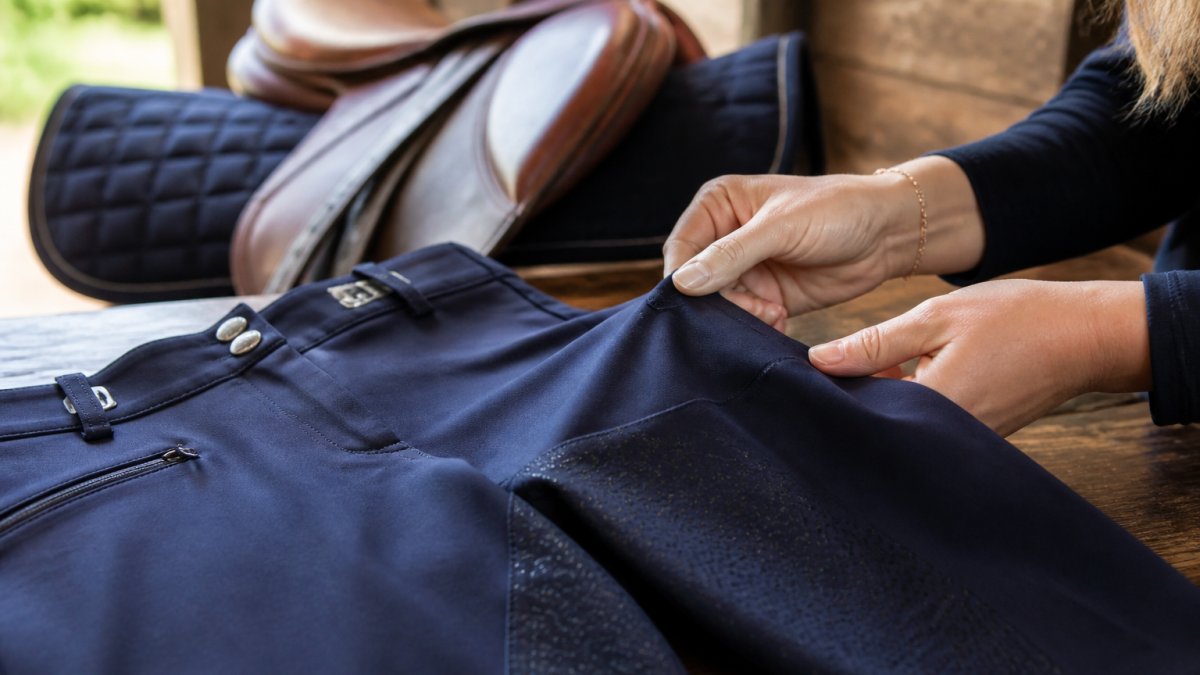
The good news? The points that fail first are always the same. Once you know what to look for, you won't be fooled again.
The five criteria to check before buying:
- Material: which fabric really resists wear and tear
- Fabric weight: a fabric that is too thin wears out quickly
- Reinforcements and seams: contact areas with the saddle
Riding breeches material: which fibers really resist wear and tear?
The material for riding breeches that lasts over time is almost always a blend: elastane for elasticity, polyamide or cotton for strength. Four-way stretch fabric follows the leg movement without losing its shape.
Fibers to know:
- Polyamide and elastane: lightweight, durable, quick-drying
- Cotton with stretch: comfortable, but wears out faster in high-friction areas
- Recycled fibers: good performance, reduced impact
Pure cotton retains moisture and causes friction. Avoid for regular use.
The role of fabric weight and density
A high fabric weight means more material per square centimeter, thus better wear resistance. A light, thin fabric is pleasant in summer, but shows wear faster at the knees and crotch. For regular use, look for a dense fabric with a firm feel. If the fabric is nearly transparent when held up to the light, it will not last.
Reinforcements and seams: the areas that fail first
Three zones fail before others: the crotch, the inner knees, and the seat seams. Good breeches reinforce these areas or place a reinforced panel there. Also check the seams: flat, tight, with no loose threads. A simple seam in a friction area is a repair waiting to happen.
How to choose the size of riding breeches (and check the fit in the saddle)
To choose the size of riding breeches, do not rely on the waist measurement taken while standing. The fit changes in the riding position: hips open, thighs lengthen, the waist shifts. Most riders who get the wrong size do so because they test while standing still.
The three-step fitting method (standing, bent, in the saddle)
- Standing, without tightening the belt: put on the breeches. They should stay up without a belt, but without digging into your waist. If you have to tighten the belt to keep them up, the size is too big.
- Knees bent at 90 degrees, as in the saddle: squat or sit on a chair with your feet tucked under you. The fabric should not pull on the thighs or sag in the back. If you feel compression at the groin or knees, go up a size.
- In the saddle, if possible: mount the horse (or sit on a saddle placed on a stand). Check that the breeches do not pull up at the knees, that the waist stays in place, and that you can move from a seated position to a two-point position without the fabric restricting you.
Precise check points (beyond the waist measurement)
- Length: in the saddle, the bottom of the breeches should cover the boot without bunching at the instep. Too long, and they will wear out under the boot; too short, and they will ride up and cause chafing.
- Seams: ensure they do not pull apart when you bend your knees. A strained seam is one that will break.
- Mobility: perform three key movements: mounting (leg raised), dismounting (flexion), and staying in balance (legs clamped). The breeches should follow without resistance.
Why standing waist measurements aren't enough
While standing, your measurements reveal nothing about your riding position. In the saddle, the angle of the pelvis changes and the thighs spread. Breeches that fit well standing can compress when riding. Others, slightly loose while standing, fit perfectly once mounted. Always test with knees bent, then in the saddle if possible. It is the only test that matters.
Checking the size according to the discipline
- Dressage: the fit should remain close to the body in the saddle, without bunching at the groin. Test with prolonged sitting.
- Jumping: prioritize a cut that does not restrict the knee-hip angle. Test in a two-point position.
- Trail riding: freedom of movement is paramount. Test by walking around before mounting.
If the fabric pulls or the waist gaps, change the size. Breeches that move in the saddle are breeches you won't wear.
Full-grip or knee-patch riding breeches: which to choose for your practice?
The choice between full-grip or knee-patch riding breeches depends on your discipline. Full-grip covers the entire inner leg. Knee patches are limited to the knees.
Grip type |
Grip strength |
Freedom of movement |
Ideal for |
|---|---|---|---|
Silicone full grip |
Maximum |
Slightly less flexible |
Dressage, jumping, competition |
Silicone knee patches |
Good at the knees |
Very free |
Leisure, trail, young riders |
Fabric patches |
Moderate |
Maximum |
Trail riding, beginner |
Silicone grip holds better on a slick saddle. Fabric patches are suitable if you are primarily looking for comfort. For competition, grip makes a difference during jumps and rapid transitions.
Riding breeches care: actions that extend their lifespan
Proper care for riding breeches extends the life of the garment more than any other action. Technical breeches washed incorrectly lose their elasticity and grip. But care goes beyond washing: drying, repair, and storage are just as important.
Washing: settings that preserve the fibers
- Temperature: 30°C (86°F) maximum. Above this, elastane degrades and the fabric loses its elasticity.
- Cycle: delicate or synthetic cycle, moderate spin (600 to 800 rpm). Excessive spinning breaks the fibers.
- Inside out: protects the silicone grip and visible seams.
- No fabric softener: it clogs the fibers and kills the grip. Replace it with half a cup of white vinegar in the softener compartment.
Drying: the mistake everyone makes
The dryer is the number one enemy of elastane. Heat breaks the elastic fibers. Afterward, the breeches will bag at the knees and never snap back.
- Air dry, in the shade, on a hanger or flat. Avoid direct sunlight: UV rays weaken the fibers.
- Do not wring out the breeches: this warps the seams.
- Turn them inside out to dry the inside first.
Repair: actions to avoid replacing them
- Failing seams: a flat seam that opens can be repaired with a straight stitch. Use polyester thread, not cotton.
- Peeling grip: if the silicone peels off in patches, the breeches are at the end of their life for competition. For leisure, you can wear them until the lack of adhesion becomes annoying.
- Crotch hole: a piece of stretch fabric can be applied to the inside, but the repair must be flat to avoid chafing.
- Worn fabric patches: they can be replaced by a saddler or a specialized tailor.
Cost per use: the true indicator
A pair of trousers at €150 that lasts three seasons (about 150 sessions) costs €1 per session. A pair of trousers at €60 that lasts six months (about 25 sessions) costs €2.40 per session. The calculation is simple: divide the price by the number of sessions before wear and tear.
To estimate lifespan:
- Heavy use (4 to 5 sessions/week): quality trousers last 1 to 2 years.
- Regular use (2 to 3 sessions/week): 2 to 3 years.
- Casual use (1 session/week): 3 to 5 years.
Storage
- Hang trousers by the waistband, not by the legs, to avoid stretching the knees.
- Avoid plastic bags: the fabric needs to breathe.
- Store them clean and dry. Humidity encourages odors and mold.
Regular maintenance takes ten minutes a week. This saves you from having to buy new trousers every six months.
Sustainability, environmental impact, and eco-friendly claims: what to check
An eco-friendly claim is worthless without proof. Recycled fibers reduce impact, but only if the fabric lasts over time. Trousers that last three years pollute less than "green" trousers repurchased every season.
What to check:
- Labels and certifications: look for evidence, not a slogan
- Detailed composition: actual percentage of recycled fibers
- Repairability: accessible seams, replaceable parts
- Cost per use: divide the price by the number of sessions
The cost per use is the real indicator. Trousers that are slightly more expensive but last twice as long cost less to use.
Conclusion: the checklist for long-lasting riding breeches
Before you buy, review this list:
- Dense fabric, not transparent against the light
- Reinforcements at the crotch and knees
- Flat, tight seams
- 90-degree knee bend test
Choosing durable riding breeches takes ten minutes of checking. This saves you from three repurchases. At Équitavi, our selection is based on technical fabrics and cuts designed for movement. Our clothing supports both rider and horse, from leisure to competition.
Need help finding the right cut? check out the French Equestrian Federation's recommendations on rider equipment and our collection.
Frequently Asked Questions
What criteria should I check to choose durable riding breeches?
Check the fabric composition (four-way stretch, fabric weight), the quality of seams in high-stress areas (crotch, knees), the presence of reinforcements at wear points, the durability of seat patches or grip, and ease of care. Durable riding breeches combine dense material, careful finishing, and a cut adapted to your body type to avoid unnecessary strain.
What material should I prefer for resistant riding breeches?
Technical fabrics blending polyamide or polyester with elastane offer a good compromise between strength, elasticity, and quick drying. Cotton alone loses its shape and wears out faster in the crotch. For regular use, favor riding breeches with a sufficient fabric weight and four-way stretch, which ensures freedom of movement and better long-term wear.
Are riding breeches with grip more durable?
Silicone grip or fabric seat patches add a layer that protects the contact area, but their durability depends mainly on the quality of the base material and maintenance. Full seat grip that is well-applied generally resists better than knee-patch grip, provided you avoid aggressive washing and high-temperature drying.
How do I care for riding breeches to make them last?
Wash your breeches at a low temperature (30°C maximum), inside out, without fabric softener, which clogs technical fibers. Avoid the tumble dryer: air drying preserves elasticity. Remove dust and sand before washing to reduce abrasion. Regularly inspect seams and promptly repair small snags to prevent them from growing.
Choosing long-lasting breeches means refusing to buy new ones every year. Équitavi offers a rigorous selection of technical clothing, with cuts designed for movement and high-performance fabrics. Our team helps you find the right fit for the comfort of both rider and horse. Discover our collection and invest in breeches that will follow you season after season.